
Bring your AI agents to everyday users
Get Started
Install the Charm CLI and publish your first AI agent in minutes.
Onboarding
Walk through the onboarding guide.
Templates
Start from a prebuilt template.
What is Charm?
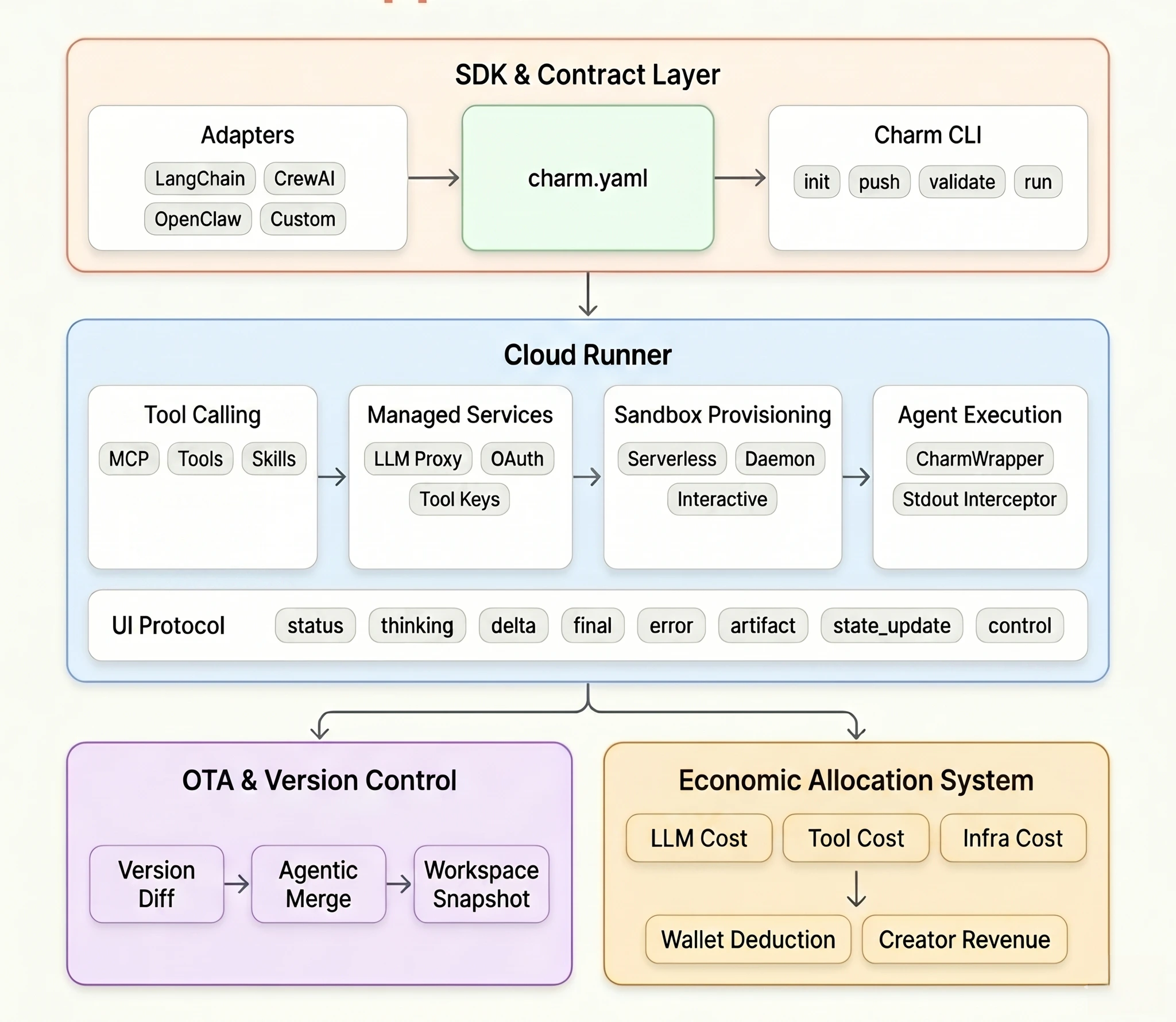
Charm is a unified application layer that provides a standardized architecture for distributing, running, and scaling AI agents across heterogeneous ecosystems — turning them into real, commercial-ready applications with a single manifest file and a few CLI commands.Why Charm?
- Ecosystem Agnostic: Bring your own framework such as CrewAI, LangChain, LangGraph, OpenClaw, or plain Python functions, Charm wraps them all with the same runtime contract.
- No Infrastructure: The Cloud Runner handles isolated container execution, secrets injection, and scaling. You write agent logic, not deployment pipelines.
- Server-Driven UI: Return Markdown or structured JSON from your agent and the Store renders timelines, comparison tables, viral cards, and article layouts automatically - no frontend code needed.
- Built-In Monetization: Set pricing in
charm.yamland Charm handles checkout, subscriptions, balance checks, and payouts. - Open Source: Charm Core, CLI, and runtime adapters are fully open source. Community contributions drive every part of the ecosystem.
Who needs Charm?
- AI Developers who have a working agent in CrewAI, LangChain, OpenClaw, or custom Python and want to ship it as a product without building infrastructure.
- AI Builders who want to monetize agents through the Charm Store with built-in billing, OAuth, and a hosted runtime.
- Everyday users who want agents as apps, not infrastructure. Zero setup, no API keys, and no need to understand how they work. Just natural interaction with the agents you need.
What do you need?
- Python 3.10+ and
piporuvfor package management. - Docker Desktop (optional) if you want to test agents locally in an isolated container sandbox that mirrors the cloud runtime.
- A Charm account for publishing to the Store — sign up at store.
How it works
Start Here
- OS
- Platform
Configuration
Define everything about your agent in a single charm.yaml manifest.
Run & Test
Execute your agent locally or simulate the cloud environment in Docker.
Highlight Features
Secrets Management
Fully managed secrets for your agents.
OAuth
Integrate with Google, GitHub, and more.
Ambient Desktop Companion
Run agents in your desktop as a native companion.
Payments
Set flexible pricing model in charm.yaml.
Community & Resources
Charm Store
Browse and run published agents on the live storefront.
Contact Us
Reach the core team for partnership, support, or enterprise inquiries.
Discord
Get help, share agents, and discuss ideas with other builders.
Blog
Follow platform updates, feature announcements, and builder spotlights.